The European Child Guarantee (ECG) is a Recommendation of the Council of the European Union (Recommendation (EU) 2021/1004 of the Council of 14 June 2021 establishing a European Child Guarantee) approved unanimously by the Member States on 14 June 2021, which aims to prevent and combat child poverty, break its cycle of intergenerational transmission and promote equal opportunities by ensuring that children and adolescents at risk of poverty or social exclusion have effective and free access to a set of basic services: Early childhood education and care, Healthcare, Education and extracurricular activities, Adequate housing, At least one healthy meal per school day, Healthy nutrition.

The European Child Guarantee in Spain
It is developed through the State Action Plan for the Implementation of the European Child Guarantee (2022-2030) approved on 5 July 2022.
Our vision of the European Child Guarantee is that…
All children and adolescents have the conditions, means, and basic services that enable them to exercise their rights, enjoy well-being, and fully develop as individuals in an equitable environment. They can live in safe environments and develop their capabilities and potential within the framework of an egalitarian and inclusive society that ensures equality of rights and opportunities from early childhood.
Our mission of the European Child Guarantee is...
To drive the implementation of measures from public administration, in close cooperation with civil society and other stakeholders, that ensure children and adolescents fully enjoy their rights equally, prevent and combat social exclusion and child poverty, ensure equal opportunities, prevent discrimination, and promote active participation of vulnerable children and adolescents in the policies that affect them, breaking the cycle of poverty and social exclusion.
Coordination of the European Child Guarantee in Spain
The Directorate-General for Children's and Adolescents' Rights (DGDIA), under the Ministry of Youth and Childhood's Secretariat of State for Youth and Childhood, is responsible for the coordination and supervision of the ECG at the state level.
The governance system of the Plan includes a political level (inter-ministerial and sectoral conferences), an operational level (between the General State Administration, Autonomous Communities/Cities, and municipalities), and a consultative level (mechanisms for the participation of civil society, children, and adolescents).
In compliance with the reporting commitments made with the European Commission, the "First Biennial Progress Report on the Implementation of the European Child Guarantee" has been prepared, detailing the initiatives to combat child poverty carried out in Spain by the General State Administration and the Autonomous Communities and Cities with the status of autonomy (CCAA), from the approval of the PAEGIE until December 2023.
For the preparation of this report, the Directorate General for Children's and Adolescents' Rights (DGDIA), under the Ministry of Youth and Childhood and responsible for the coordination and supervision of the GIE at the state level, has consulted with ministries, the CCAA, the Spanish Federation of Municipalities and Provinces (FEMP), and public bodies that are implementing measures within their competences that contribute to achieving the objectives of the PAEGIE, State Action Plan for the Implementation of the GIE (2022-2030). Each entity has provided essential information, reflecting the actions carried out both with their own administration’s funds and with funds from the General State Budgets and European Union financing.
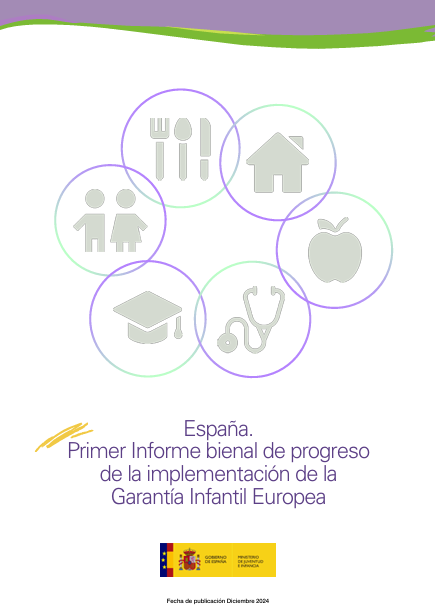
First Biennial Progress Report on the Implementation of the ECG
English version (Biennial progress report ECG)
Automatically translated with OpenAI from Spanish